
Outsourcing Growth, And The Cold (Storage Monitoring) Truth

By Louis Garguilo, Chief Editor, Outsourced Pharma

Here I go again, combining outsourcing reports.
The first of the superimposed reports deals with a precise subject that suggests attributes well beyond its focus on cold chain monitoring in our drug industry.
The second, conversely, is an analysis of the entire pharmaceutical contract manufacturing market that allows us to draw down some interesting specifics.
What brings these reports together – both from MarketsandMarkets – is growth, and the various components and interpretations of that growth.
Propelling development and manufacturing outsourcing today is a desire for more but better of the same, coupled with a need for additional services, and a certain business and technological maturation.
The cold chain monitoring report is a specific example of these components of growth that are indicated in the second, biopharma-outsourcing market report.
That second report tells us the contract manufacturing market is “undergoing a significant transformation driven by advancements in technology, evolving regulatory frameworks, and shifting client demands.”
MarketsandMarkets estimates this overall market can grow at a 8.2% clip over the next five years, to $312 billion.
Recently, this growth is attributed to rising requests targeting specialized capabilities and sophisticated platforms for cell-and-gene therapies, peptides, ADCs and mAbs, radiopharmaceuticals, oligonucleotides, complex injectables, and so on.
Speaking to maturity, the report says:
“… growth is segmented by the adoption of continuous manufacturing, single-use bioreactor systems, and advanced process analytics enabling greater efficiency, scalability, and cost-effectiveness in drug production. The rise of cell and gene therapies is prompting CDMOs to invest in specialized viral vector manufacturing, automated fill-finish systems, and high-containment facilities to meet stringent quality and biosafety standards.”
My overall analysis of this first report is that sponsors more than ever are contracting for advanced expertise, for example:
- AI-enhanced (discovery and) development capabilities – nary a CDMO neglects to advertise AI-added capabilities in the realms of “discovery and development” – because innovators now understand the competitive value-add of fully AI-savvy partners.
- Critical and expanded analytical support – which biotech entrepreneur/executive (and Outsourced Pharma Advisory Board member) Darren Dasburg says is the service-side upgrade and growth most desired in our industry.
Here’s where our second MarketsandMarkets report comes into play. The cold chain monitoring service supports “growth” to our markets in terms of the three components above: more of the same (but better), additional services, and the maturity of our drug industry.
Some recent CDMO announcements regarding cold chains:
- Sharp made an investment of ~$23 million to expand injectable packaging, assembly, and cold-chain storage across sites in Belgium and the Netherlands
- PCI Pharma Services committed over $1 billion to U.S. and Europe capacity, with sites providing packaging for oral solid doses and injectables including cold chain storage and large-scale commercial supply
- Almac completed a cold chain expansion at its Craigavon headquarters
- Aenova is opening a 6,500-cubic-meter cold chain warehouse at its sterile manufacturing site in Latina, Italy
According to a MarketsandMarkets analyst, CDMOs are adding sterile suites, cold-chain capabilities, lyophilization capacity, and device assembly lines as sponsors increasingly prefer partners integrated from formulation through commercial production in one network."
I’ve learned cold-chain monitoring is a whole sub-industry unto its own. MarketsandMarkets sent over this chart for some elucidation:
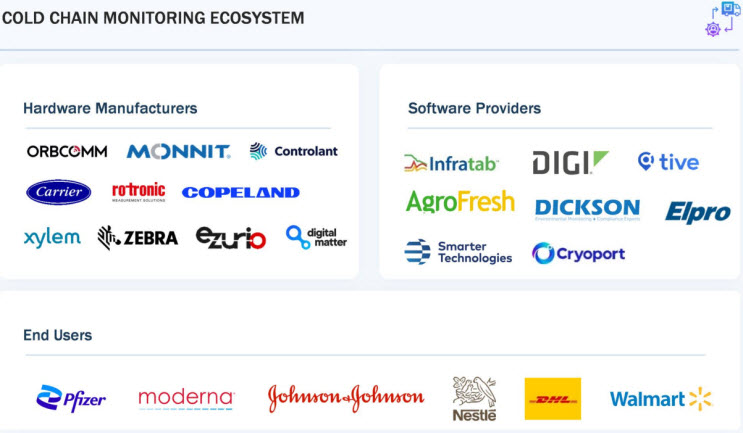
We aren’t endorsing any company – and I’m assured there are plenty more that could be included – but this chart provides a simple starting point. When considering monitoring, we are talking about requisite and advancing hardware and software (and of course, their integration).
The report notes cold chain needs run through various industries, but “the pharmaceuticals & healthcare sector remains the most critical, owing to the surging demand for biologics, vaccines, blood products, and precision medicines that require strict temperature compliance to maintain efficacy.”
Today, sophisticated cold-chain systems exist to protect monoclonal antibodies and mRNA medicines to gene therapies, stem cells, blood products, the transport and storing of so many varying clinical-trial materials, and DNA and tissue samples maintained in biobanks.
Our medicines often require outsourced chains that provide refrigerated storage between 2°C and 8°C, with growing demands for ultra-cold environments from -20°C to -80°C. Cell and gene therapies, for example, may require cryogenic storage below -130°C to preserve viability.
Each temperature range demands different equipment, monitoring technologies (the hardware and software mentioned above), transportation systems, contingency planning, and specialized expertise.
Logistics, so to speak, has further lodged itself into development and manufacturing. Separation of thought by sponsor or CDMO of product development from cold-chain requirements can leave both, pun intended, out in the cold when looking to optimize outcomes for the (back-and-forth) transport of patient and product materials to a growing number of varying settings and locales.
Cold chain has become its own sophisticated digital quality system. The MarketsandMarkets report tells us modern cold-chain monitoring incorporates:
- IoT-enabled sensors
- continuous temperature and humidity monitoring and automated alerts
- predictive analytics, real-time tracking
- complete data logging throughout storage and transportation
In other words, no more sour surprises of discovering problems after delivery. Sponsors and service providers rely on immediate visibility into changing conditions, so corrective action can occur before product integrity is compromised.
CDMOs need to be involved whether contracting or directly offering a delivery service to customers, and today are often considered a component of the cold chain. A CDMO’s receiving, handling, processing, and storing of materials and products is vital: the digital handling and distribution profile of a drug substance or product is as important as its practical properties.
Today, due diligence on a CDMO increasingly includes evaluating capabilities that were once associated primarily with specialized logistics providers.
Back To The Universal Look
I’ll wrap this up by bringing us back to how cold storage monitoring provides a prime example of where we are headed – what growth looks like in our outsourcing industry today.
No better way to do that than to let you peruse the following chart from the MarketsandMarkets overall outsourcing market report – what to my eyes is an elegant depiction of our industry from past to projected future.
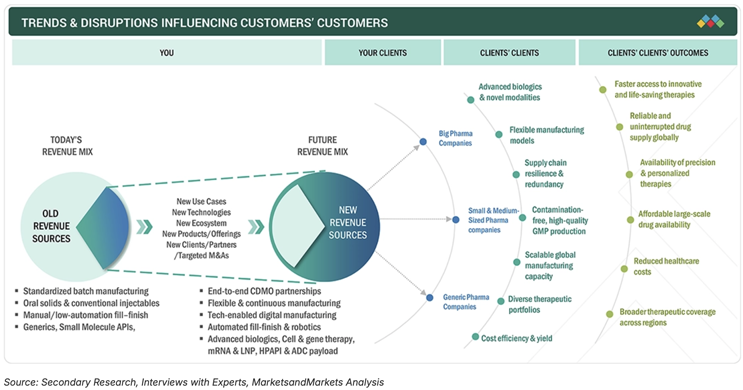
We are growing – more of everything but better; additional integrated services; and in science and outsourcing maturity.
Let’s keep it going, and very cold when needed.