
Using Compaction Simulation To Support Tablet Technology Transfer And Scale-Up
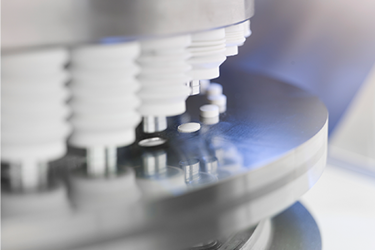
Technology transfer is one of those moments where a formulation that performed perfectly in development can quietly fall apart. Compression parameters shift, lubrication levels creep up, and suddenly you're troubleshooting lamination or tablet strength failures at commercial scale. That's exactly the risk the team faced during scale-up of a 40 mg fexuprazan tablet formulation.
Rather than burning through material on trial-and-error batches, the team used OSD Predict™ compaction simulation tools, running studies on a Gerteis MINI-PACTOR® roller compactor and a Fette 1200i rotary tablet press to replicate manufacturing conditions. Heckel analysis confirmed a yield pressure of 78.5 MPa and strain-rate sensitivity of 15.9%, pointing to a balanced ductile/brittle deformation profile that required careful parameter control.
Roller compaction studies pinpointed a solid-fraction target of 0.6–0.7, achieved with roll forces between 3 and 4 kN/cm. Lubrication experiments confirmed where over-blending starts to cost you tablet strength. The result: a defined processing window that held up through scale-up, with far less material consumed than conventional development would require.
Access the full case study to see how these simulation methods translate into a replicable tech transfer framework for your OSD programs.
Get unlimited access to:




Enter your credentials below to log in. Not yet a member of Outsourced Pharma? Subscribe today.