
How To Build A Medicine When Someone Is Waiting For A Dose

By Jeffrey S. Buguliskis, PhD, Deputy Chief Editor, Outsourced Pharma

Ask a passerby outside Fenway Park what a contract development and manufacturing organization does, and you will get a blank stare. Yet, about a mile and a half east, inside the Sheraton Boston during the CDMO Live Americas 2026 conference, hundreds of biopharma leaders wrestled with a quiet reality: more than 90 percent of biotechs rely on external partners to turn molecules into medicines. Biology is hard enough. The human systems we build to scale it are harder still.
Across both conference tracks, one diagnosis surfaced repeatedly: the sector lacks neither ambition nor stainless steel. It suffers from an execution gap.
In the session entitled "External Manufacturing Index Reveals Critical Partnership Gaps," Simon-Kucher consultants shared their industry survey. While "goal alignment" reached 77 to 83 percent for established pharma, expectation fulfillment plunged to 40 to 44 percent. Sponsors praised daily communication, yet most said few partners delivered on flexible pricing or scalability. The relationship layer is warm, but the machinery beneath it is grinding.
Even the sector's core assumption is shifting. While nearly half of CDMOs expect outsourcing to grow, 54 percent of surveyed pharma leaders with internal plants plan to insource more. "Your most important competitor may not be another CDMO," one Simon-Kucher presenter warned. "It is your customer’s own manufacturing network."
Tariffs and Delayed CapEx Create a Short-Term U.S. Outsourcing Wave
That divide was a central theme in "The State of Contract Manufacturing in North America 2026" session, where panelists warned that Washington tariff deals favor big pharma over smaller biotechs. Later, in "DC Decoded: An Insider's Guide to Pharmaceutical Supply Chain Policy," Marta Wosińska, senior fellow at the Brookings Institution, showed how national-security trade probes under Section 232 of the Trade Expansion Act split the industry. She noted that major drugmakers can cut deals with Washington and shift production globally, but smaller sponsors sit behind them with limited resources to negotiate better terms.
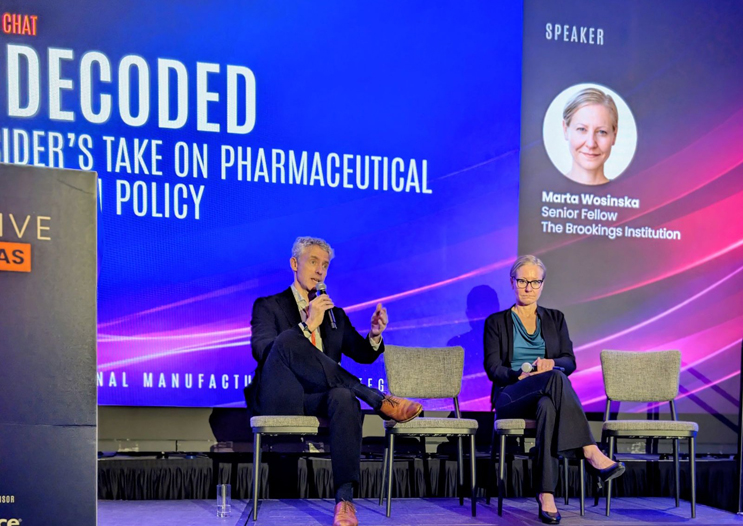
DC Decoded session featuring Gil Roth and Marta Wosińska
For European-made drugs, absorbing a moderate tariff beats a tech transfer; real migration is confined to countries facing steep tariffs. Meanwhile, during the lightning talk round entitled "Trend Briefings: Trends Shaping Biopharma Outsourcing," Adam Siebert, managing director at L.E.K. Consulting, showed that of $600 billion in U.S. pharma capital pledges, only $70 billion has a concrete site, date, and purpose. Until those plants open, U.S. CDMOs face a wave of overflow demand.
"It’s a huge mistake for you to think about geography, and an even bigger mistake to think that tariffs will save you," said Reza Oliyai, president of Oliyai Consulting. "That simply will not happen." Sponsors locking in U.S. capacity should structure multi-year contracts that secure batch slots without overpaying for a domestic zip code.
Sponsors Are Screening CDMOs Before the RFP
Because geography offers no safety net, sponsors filter for certainty before an RFP lands. In the Trend Briefings, Samir Panjwani, creator of CDMO Signal, showed how buyers screen suppliers digitally by modality, scale, and FDA inspection history before making a call. The RFP is now the visible end of a search, not the start.
Digital screening works only if a sponsor knows what its molecule needs at scale. In the "CMC Strategy for Funding Success: What Investors Evaluate at Each Stage and How to Demonstrate Readiness" session, Ray Forslund, EVP of product development at Syner-G Biopharma, described late-stage assets from China arriving with pre-clinical CMC plans, turning a $1 million filing sprint into a $10 million rebuild. "You don't have control over what the molecule does in your body," Forslund said. "But you have control over how you make that molecule." Sponsors should audit their process assumptions and verify a CDMO's inspection record before issuing an RFP.
Deferring Early CMC Work Multiplies Downstream Costs
Closing that gap starts at the bench, where teams mistake narrow lab batches for commercial scalability. In "De-Risking Small Molecule CMC: Decision Gates, Global Capacity and Supply Strategy," Stefanie Roeper, senior director of process chemistry at Vertex, seats process chemists beside medicinal chemists before lead selection to flag thermal and supply risks. "If you're not in the room down the road, then you're on the rescue mission," Roeper stated.
The same foresight governs antibody-drug conjugates (ADCs). During the panel discussion entitled "Scaling ADC Development Strategy: Solving Conjugation Chemistry and Analytical Complexity Early," Gerard Jensen of Oliyai Consulting noted that engineered "Frankenstein proteins" invite aggregation during conjugation and freeze-drying. Deferring formulation work, said Destardi Moye-Sherman, principal consultant at Moye Consulting Group, is "a bill that's going to have to get paid." Another ADC panelist shelved a new fill-finish line after clients refused to be "first in line," pre-qualifying a specialist filler instead.
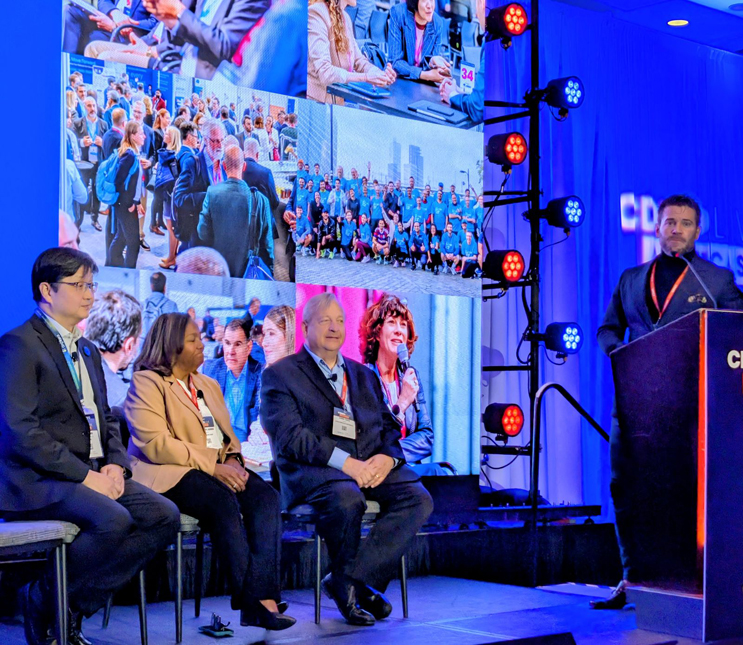
Session on “Scaling ADC Development Strategy: Solving Conjugation Chemistry and Analytical Complexity Early”, featuring (from left) Jin Seok Hur, Destardi Moye-Sherman, Gerard Jensen, and moderated by Ben Locwin
In the panel "Solving CGT Manufacturing at Scale," Michael Mercaldi, VP at Torque Bio, described shifting adeno-associated virus (AAV) production to inducible cell lines. At the same time, Craig Martin, CEO of the Orphan Therapeutics Accelerator, stacks rare lentiviral programs onto shared CDMO slots. Sponsors should fund early process work and favor CDMOs with pre-qualified specialist alliances over untested one-stop shops.
Smart Network Design Beats Blind Vendor Diversification
In "Resilience by Design: How Vertex Are Embedding Risk Management into Manufacturing Network Strategy," Alfredo Vidal, director of risk management at Vertex, described embedding "Risk Champions" across disease areas to protect supply. In "Manufacturing Network Optimization Strategies: Consolidation, Regionalization or Dual-Sourcing?," Joseph Graskemper, GM of early-phase development and manufacturing at Biogen and Outsourced Pharma editorial board member, warned against adding vendors blindly: "A diversified network does not mean a more resilient network. It could just be a network with more headaches."
Biogen instead dual-sources across U.S. and European sites within the same CDMO. At the same time, Gretchen Peck, senior director of strategy and program management at Pfizer, noted that only two of Pfizer's 300-plus CMOs hold enterprise strategic status. As one panelist summed up the trade-off: "You can't have your cake and eat it too. You can't have redundancy, the cost of network consolidation, and the flexibility of no commitment." Consolidating dual-region redundancy inside one multi-site CDMO gives sponsors more leverage than managing a dozen vendors.
Digital Batch Release and Carbon Data Now Gate Market Access
Even a sound network stalls on paper. In the second round of lightning talks entitled "Real-World Case Studies in Digital Manufacturing," Jose Andino, tech transfer manager at mAbxience, showed how electronic batch records cut release times from 100 days to 40, while a Pfizer presenter used agentic AI to run site-readiness checks in minutes. However, at Sanofi, where "golden batch" models lifted yields, Inna Ben-Anat, global head of smart factories, stressed that scaling AI has "no shortcuts" around clean master data.
In the session on "Operationalizing Decarbonization: How To Close The Pharma-CDMO Gap," panelists noted that European health systems bar drugmakers from tenders without climate disclosures, with France demanding dose-level carbon data. To cut Scope 3 supply-chain emissions, Rondu Vincent, executive director of global responsible sourcing at Bristol Myers Squibb, explained that BMS funds free consulting so 75 percent of its suppliers set science-based targets. Sponsors must treat electronic batch records and carbon tracking as prerequisites for fast release and access to the European market.
By the time we gathered for "Takeaways from CDMO Live Americas 2026," those threads had converged, from orchestrating radioligand delivery to holding sterile capacity like a restaurant reservation. Stop treating "strategic partnership" as a polite synonym for a vendor contract. Put the process chemists, risk modelers, and business leaders in the room before the ink dries on a protocol, because at the end of every batch record, someone is waiting for a dose.
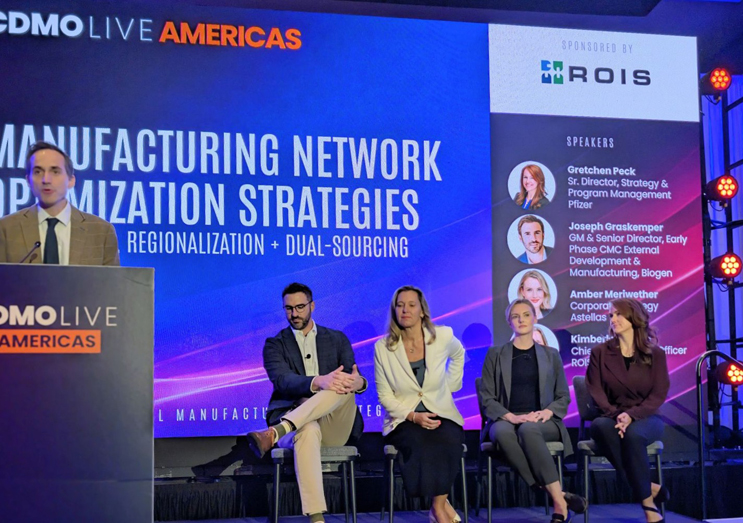
Session on “Manufacturing Network Optimization Strategies: Consolidation, Regionalization or Dual-Sourcing?” Moderated by Luke Bilton (left) and featuring Joseph Graskemper, Kimberlee Steele, Amber Meriwether, and Gretchen Peck
Real Partnerships Are Engineered Before a Crisis Hits
Ultimately, every operational fix discussed in Boston pointed toward a single goal: removing friction between the reactor and the bedside. For instance, during the Trend Briefings lightning talks, Molly McGaughan, co-founder and managing director of Firm, reminded the room that manufacturing a vial is only part of delivering a treatment. When early supply constraints forced Novartis to pause new patient starts for its radioligand therapy Pluvicto, the company invested not just in manufacturing plants, but in the scheduling, logistics, and real-time tracking infrastructure around them. Today, orders arrive in less than five days, and 99.5 percent of patient injections happen on their scheduled day.
Building that kind of reliability requires commercial models that match the scientific risk of drug development. On the network optimization panel, Kimberlee Steele, chief commercial officer at ROIS, compared smart capacity planning to holding a table at a busy restaurant. Rather than forcing a biotech to sign rigid volume commitments for a single unproven drug, CDMOs can let sponsors reserve flexible blocks of sterile suite time across a wider portfolio, shifting the slot to whichever molecule advances. And when a batch fails on the shop floor, as Moye-Sherman observed in the ADC session, partnerships survive only when both sides skip finger-pointing to diagnose the root cause together.
By the time Ben Locwin of Reliant Life Sciences, Jennifer Chadwick of JC Consulting, Raman Sehgal of Molecule to Market, and I took the stage for the closing panel, "Takeaways from CDMO Live Americas 2026," the week's lesson had crystallized. The real gap in biopharma outsourcing is not capability; it is the hard conversations around pricing, governance, and risk that both sides keep deferring until a crisis hits. Stop treating "strategic partnership" as a polite synonym for a vendor contract. Put the process chemists, the risk modelers, and the business leaders in the room before the ink dries on a protocol or a legal template, because at the end of every batch record, someone is waiting for a dose.