
At INTERPHEX 2026 A Smarter Outsourcing Playbook Comes Into Focus

By Jeffrey S. Buguliskis, PhD, Deputy Chief Editor, Outsourced Pharma
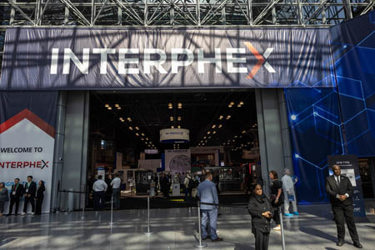
There’s a version of an industry conference that feels like a highlight reel: polished success stories, carefully managed optimism, and applause right on cue. The COEX (Contract and Outsourcing Exchange) Stage at Interphex 2026 wasn’t that. Over the course of a lovely spring afternoon at NYC's Javits Center, four presentations tackled AI transparency, geopolitical disruption, market economics, and the still-surprisingly stubborn issue of sponsor-CDMO communication. What made the sessions stand out was their candor. At times, it felt less like a conference and more like a working session among people trying to solve the same urgent problems.
The common thread running through all four talks was clear: outsourcing relationships are being tested from several directions at once, and the sponsors that come out ahead will be the ones that understand what’s really changing and what they need to ask for in response.
Explainability First: Rethinking What AI Actually Owes You
Seungik Cho, Director of Strategic Operations at Nucleate, Korea, opened the stage with a sharp question for the audience: if a CDMO’s AI platform flags a batch deviation, can it explain why in a way that would hold up under GMP scrutiny? For most platforms on the market today, the answer is still no.
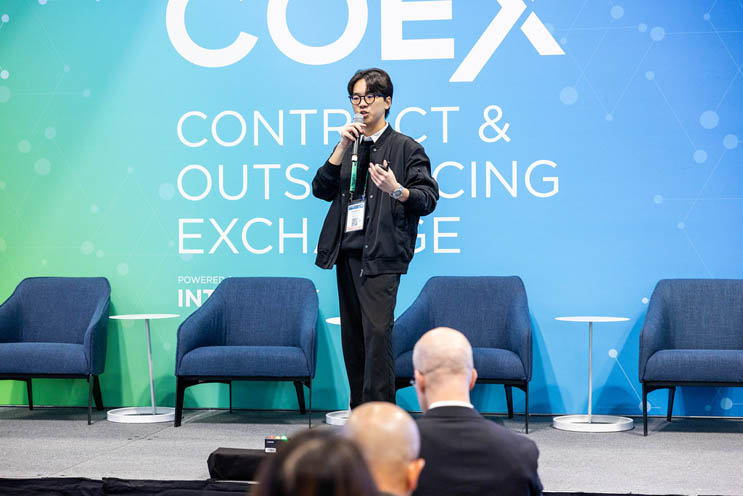
Seungik Cho opens the COEX Stage with a presentation on explainable AI and digital twins, arguing that sponsor teams need tools that do more than predict outcomes. [Image Courtesy of Interphex 2026]
Using an industrial-scale bioprocess benchmark involving 100,000-liter fed-batch penicillin fermentation across 100 batches, Cho laid out a three-layer architecture designed to close that gap. The first layer involved lightweight soft sensors that could track in-process performance and quality-related signals in real time from online data. Because those models are easier to validate and to explain to quality assurance teams, they are better suited for tech transfer and regulatory review.
The second layer focused on what Cho called “failure signatures”-deviations from a “golden corridor” of high-yield batch behavior. Early changes in oxygen uptake rate, dissolved oxygen, and feed rate can signal metabolic failures hours before a batch actually ends. Finally, the third layer brought everything together into a knowledge graph containing roughly 7,000 semantic triples that link batches, recipes, deviations, corrective actions, and outcomes, forming a searchable institutional memory.
For drug sponsors, the practical takeaway isn’t that AI is about to run the plant on its own. It’s that a well-designed system should allow a CDMO to answer specific, useful questions, such as which previous campaigns showed a similar deviation pattern, rather than just flashing a dashboard alert with no context. If a CDMO can’t clearly explain the logic and structure behind its digital tools, that’s a weakness worth pressing on.
Biotech Whiplash: The Geopolitical Disruption You Can’t Ignore
Moderated by Brian Scanlan of Freedom Bioscience Partners, the next panel may have been the most important 45 minutes of the day for anyone responsible for sourcing strategy. One data point stood out immediately: nearly 40% of global pharma licensing deals in the first quarter of 2026 originated from Chinese innovation. That number has climbed sharply over the past five years and, in some modalities, is now nearing parity with U.S.-originated assets.
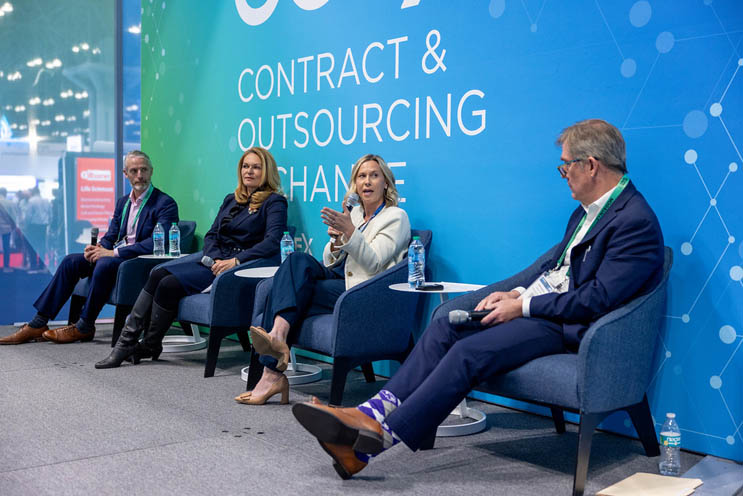
[From left] Panelists Gil Roth, Stella Vnok, Allison Vavala, and Brian Scanlan in the “Biotech Whiplash” discussion examine how Chinese innovation, shifting policy, and regional supply chain pressures are reshaping global outsourcing strategy. [Image Courtesy of Interphex 2026]
Gil Roth of the Pharma and Biopharma Outsourcing Association clearly laid out the policy side. The BIOSECURE Act’s 2025 revision gives companies working with listed Chinese entities a five-year decoupling window, but it doesn’t solve the deeper issue of innovation shifting eastward. Allison Vavala of Flamma, a CDMO with operations in Italy, the United States, and China, described how sponsor behavior has evolved. The first wave of “get out of China” RFPs has given way to something more measured. Sponsors aren’t necessarily walking away from China. Instead, many are pursuing a “China plus one” model, building more resilient regional supply chains without abandoning relationships that took years to establish.
Stella Vnook, chief executive officer of Kaida Biopharma, offered one of the session’s most pointed observations. Many Chinese-origin assets entering Western licensing pipelines are Phase 1-ready or already beyond Phase 1, which shortens the clinical path. But the manufacturing assumptions built into those assets don’t always line up with FDA expectations. That disconnect requires active sponsor involvement. It can’t simply be handed off to a CDMO. Vnook’s advice was straightforward: start evaluating manufacturing options earlier, use AI where it genuinely improves decision-making, and work with the FDA, not around it, as sponsors push newer modalities toward development and manufacturing.
There’s an optimistic way to read all of this. Chinese innovators are increasingly developing drugs for global markets, which means they still need Western CDMOs, Western regulatory pathways, and Western manufacturing partners. The disruption is real, but so is the opportunity. Especially for sponsors that move quickly enough to position themselves as preferred development partners for in-licensed assets.
The Market Is Growing. Your Strategy Has to Keep Up.
Ravi Narayanan, commercial vice president (VP) at DuPont, pulled back to give a broader market view, which helped ground the earlier discussions in economic reality. The biopharma CDMO market currently sits at about $20 billion and is projected to reach $50 billion by 2034, growing at a compound annual growth rate of 8% to 12%. At that pace, the market roughly doubles every seven to nine years. The medical device CDMO segment is even larger and is expanding at a similar rate.
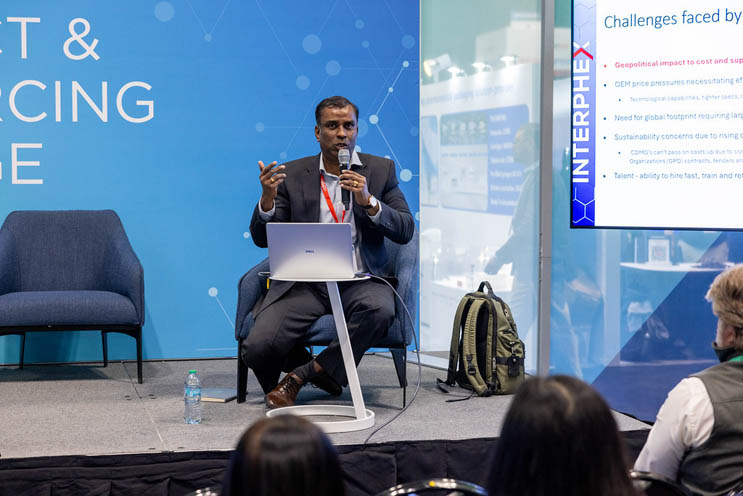
Ravi Narayanan outlines the market forces reshaping the CDMO landscape, including pricing pressure, workforce constraints, onshoring, and regulatory complexity. [Image Courtesy of Interphex 2026]
The forces behind that growth are familiar enough: more complex pipelines, more biologics manufacturing being outsourced, an industry shift toward oncology and specialty modalities, and the high cost of maintaining in-house manufacturing infrastructure. Narayanan’s case was simple and compelling. Sponsors can focus on advancing therapies because CDMOs handle the heavy lifting of manufacturing expertise, regulatory compliance, and global capacity.
But growth also creates its own pressures. Tariffs are reshaping the movement of raw materials and finished goods. Onshoring efforts may be strategically appealing, but they take years to turn into usable capacity. Workforce shortages in specialized manufacturing remain real. And regulatory complexity, especially around contamination control, aseptic processing, and Annex 1 expectations in Europe, continues to raise the bar for what counts as a credible CDMO partner.
Yet for sponsors, the message was hard to miss. Choosing a vendor based only on price and available capacity isn’t enough anymore. Technical depth, compliance strength, and geographic flexibility all need to be part of the equation.
The Partnership Problem Is Still a People Problem
The final session, moderated by Tom Wilson and featuring Ray Sison, Nicole Strauss, and Elena Polansky, brought the afternoon back to one of outsourcing’s oldest truths: no matter how advanced the technology or how strong the market demand, a program can still get stuck if the people and processes around the relationship aren’t working.
What made this panel especially useful was that it didn’t treat “partnership” as a vague ideal. It treated it as something practical, structured, and, in some cases, conditional. Polansky, drawing on her procurement background, made the point that partnership isn’t just about goodwill. It depends on shared goals, clear governance, and agreed definitions of success. If those things aren’t established early, what starts as alignment can quickly deteriorate when timelines slip or unexpected issues arise.
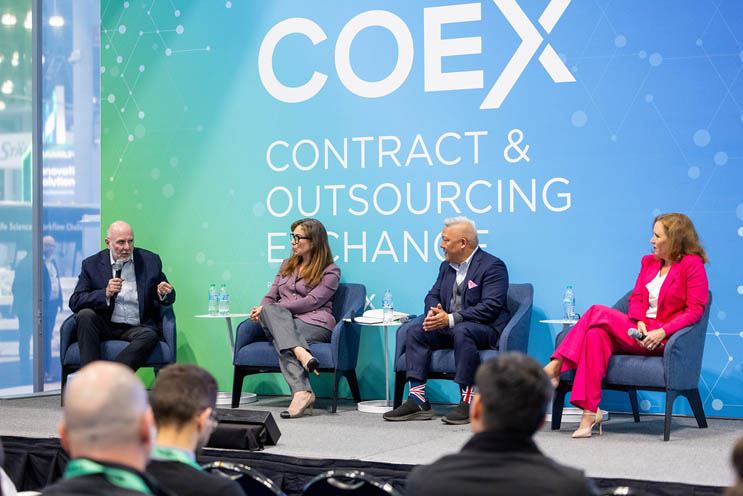
The final COEX panel, [from left] Tom Wilson, Elena Polansky, Ray Sison, and Nicole Strauss, turns to the operational side of outsourcing, with speakers emphasizing governance, transparency, and the value of experienced CMC guidance for emerging sponsors. [Image Courtesy of Interphex 2026]
Sison added an important nuance from the early-stage biotech side. For smaller companies trying to advance an asset with limited internal infrastructure, the most durable relationship isn’t always directly with the CDMO. In many cases, it is with an experienced CMC consultant who knows the provider landscape, has trusted relationships across multiple organizations, and can help guide sourcing and operational decisions as a program evolves. For early-stage biotechs, a strong consultant can serve as both interpreter and intermediary, helping companies move faster, make better choices, and avoid costly misalignment with service providers.
Strauss helped ground the conversation in what partnership looks like once the work is underway. Transparency came through as a central theme. When something goes wrong, or even looks like it might, sponsors need more than a delayed explanation after the fact. They need early visibility, real-time updates, and a sense that the CDMO is evaluating the issue in the context of the broader program, not just its own internal operations. That kind of communication doesn’t eliminate problems, but it does make them easier to manage.
Taken together, the panel’s message was both simple and practical: strong outsourcing relationships are built before the crisis arrives. That means agreeing on expectations up front, setting escalation paths early, and recognizing that, for some sponsor organizations, especially earlier-stage companies, the right advisor can be just as important as the right CDMO. The best outsourcing relationships aren’t defined only by technical execution. They’re defined by how well the right people help a program stay on course when execution gets messy.
The Through-Line
Four presentations in one afternoon covered a lot of territory: AI architecture, geopolitical sourcing strategy, CDMO market growth, and the fundamentals of making partnerships work. But the message across all four was remarkably consistent. The outsourcing environment has changed enough that passive, transactional CDMO relationships just won’t cut it anymore.
The sponsors most likely to succeed over the next few years will be the ones that demand explainability from AI tools, engage directly with geopolitical complexity instead of hoping it settles on its own, evaluate CDMOs based on technical fit rather than headline capacity, and invest in the structures that make partnerships actually function and protect timelines.
None of that’s easy. But as the speakers on the COEX Stage made clear, neither is the alternative.