
Why Analytical Characterization Now Drives Biosimilar Development
By Greg Adams, Ph.D., Head of Biopharma Science

Biosimilars offer the potential to make lifesaving treatments more accessible to patients. As developers seek more efficient pathways to demonstrate biosimilarity, regulatory expectations continue to evolve. The FDA's 2025 draft guidance shifts greater emphasis toward Comparative Analytical Assessment (CAA), recognizing that comprehensive analytical characterization can provide a more sensitive and scientifically robust demonstration of biosimilarity than comparative clinical efficacy studies in many situations.
Although the industry has historically evaluated biosimilars through comparative clinical trials, for therapeutic proteins, especially monoclonal antibodies (mAbs), clinical studies are often not the most sensitive method for detecting product differences. Analytical methods can detect differences in structure, heterogeneity, variants, impurities, and function with greater sensitivity than clinical endpoints. The updated FDA guidance establishes that sponsors should generate comprehensive, comparative physicochemical and functional data early in development to define what residual uncertainty remains and what additional clinical or non-clinical work is needed.
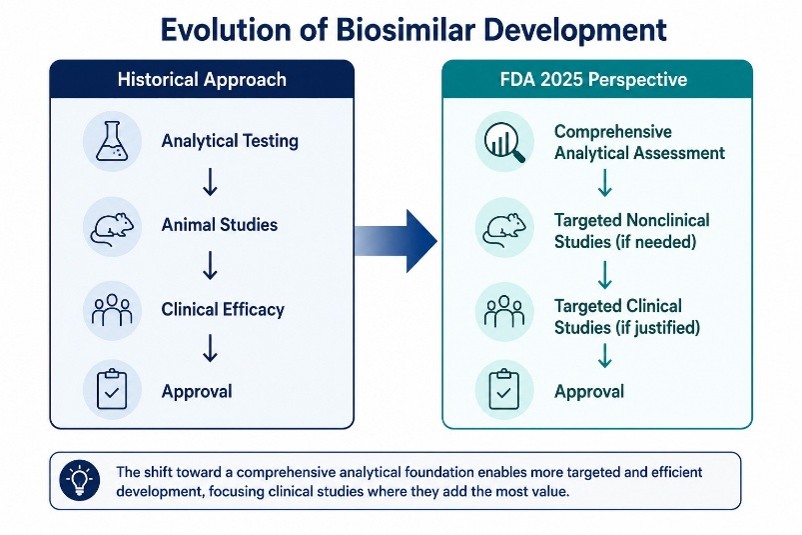
The takeaway is not that clinical studies are irrelevant for biosimilar developers; rather, strong analytical data enables more effective and targeted development programs. The better a sponsor understands the proposed biosimilar and the reference product at the molecular level, the more scientifically justified their development strategy becomes.
Analytical Confidence Is Key
Demonstrating biosimilarity differs fundamentally from establishing generic equivalence. While small molecules can often be characterized through relatively direct structural analysis, biologics are inherently complex and heterogeneous. Demonstrating biosimilarity therefore requires a comprehensive analytical understanding of the proposed biosimilar and the reference product to establish analytical similarity with scientific confidence.
mAbs are not single, uniform molecular entities; they are populations of closely related molecular forms. Even when the intended amino acid sequence is the same, differences can still exist in glycosylation, charge variants, oxidation, deamidation, clipping, aggregation, disulfide structure, and higher-order conformation. For example:
- Glycosylation affects Fc receptor binding and effector function
- Aggregates influence purity, stability, and immunogenicity risk
- Oxidation or deamidation in sensitive regions impacts binding or potency
- Charge variants reflect underlying chemical or structural differences
Although these differences may not be clinically meaningful, they must be well understood to support a biosimilar submission. An orthogonal approach is integral because different methods confirm mass, resolve charge heterogeneity, detect aggregation, and assess biological activity. No single assay will describe the full product. The CAA brings these analytical findings together into a coherent demonstration of biosimilarity.
Building A Scientifically Defensible CAA
A CAA is a structured, head-to-head comparison of a proposed biosimilar and its reference product. Under the updated guidance, it must demonstrate that the proposed biosimilar is highly similar to the reference product, notwithstanding minor differences in clinically inactive components, and that there are no clinically meaningful differences in safety, purity, or potency. A strong CAA is more than a list of assays ― it is a scientifically justified argument supported by complementary analytical evidence.
It begins with a thorough understanding of the reference product, its mechanism(s) of action, and critical quality attributes (CQAs) most likely to affect clinical performance. These attributes are ranked by risk, and the analytical strategy is built around those risk rankings. For example, an attribute directly linked to potency, Fc function, immunogenicity, or safety would receive greater scrutiny than an attribute with limited clinical relevance. The analytical methods, number of lots, data analysis approach, and similarity criteria should all reflect that risk-based framework. The objective is not to perform every available analytical test, but to generate the right evidence using sensitive, orthogonal methods that collectively support a scientifically defensible conclusion of biosimilarity.
For a mAb biosimilar, the analytical package typically spans several major domains. The first is identity and primary structure to confirm the amino acid sequence, molecular mass, chain assembly, and disulfide connectivity. Next, there is higher-order structure, which evaluates secondary, tertiary, and quaternary structure using orthogonal biophysical approaches. Glycosylation is another major factor, particularly for antibodies with Fc-mediated functions. Sponsors must also assess charge and size variants, aggregates, fragments, product-related impurities, process-related impurities, and relevant post-translational modifications. The CAA integrates structural, physicochemical, impurity, functional, and stability data across multiple lots of both the reference product and proposed biosimilar.
Connecting Structural Similarity To Biological Function
Functional assays are where the analytical comparison begins to connect most directly to the mechanism of action. Structural similarity is essential, but sponsors also need to show that the biological activities relevant to the product are comparable. Depending on the antibody’s mechanism of action, this may evaluate target binding, receptor binding, relative potency, neutralization, Fcγ receptor binding, FcRn binding, antibody-dependent cellular cytotoxicity (ADCC), complement dependent cytotoxicity (CDC), or other cell-based functional assays. For monoclonal antibodies, this often means looking separately at Fab- and Fc-mediated functions. The Fab region can drive target binding, neutralization, receptor blockade, or signaling inhibition, while the Fc region can influence Fcγ receptor binding, ADCC, CDC, C1q binding, or FcRn binding, depending on the antibody and indication.
Functional assays should be selected based on the known and potential mechanisms of action of the reference product. A biosimilar to an antibody where ADCC is clinically relevant will need a different emphasis than a biosimilar where the primary activity is ligand neutralization. Functional assays also help interpret structural differences. For example, if a glycan profile is slightly different, Fc receptor binding or ADCC data helps determine whether that difference is likely to matter. If oxidation is observed near a binding region, antigen-binding or potency data will help assess its impact. In that way, functional testing serves as more than a characterization exercise. It provides the interpretive bridge between molecular characterization and clinical relevance.
A Strategic Approach To Reference Product Variability
Reference product variability is one of the most important considerations in a biosimilar program. The reference product is not a single fixed analytical target. It has its own lot-to-lot variability, and in some cases, that variability shifts over time due to manufacturing changes, process improvements, or normal lifecycle management.
Biosimilar developers need to characterize an appropriate number of reference product lots to understand the product’s natural analytical variability. The FDA emphasizes evaluating multiple lots of the reference product and the proposed biosimilar, with the number of lots scientifically justified. The guidance also notes that acceptance criteria should be based not only on the observed range of reference product attributes but on the totality of analytical data and the potential impact of an attribute on the patient.
If a sponsor treats the reference range as a statistical exercise, they may miss the clinical relevance of the attribute. Some attributes act in combination, while others have a narrow functional threshold. Sponsors should not just focus on whether the biosimilar falls within the observed reference range, but also whether any observed differences are clinically meaningful with respect to safety, purity, potency, immunogenicity, or efficacy. A strong strategy helps define the similarity space and reduces the risk of surprises later in development.
The Impact Of Stability And Degradation Studies
Once natural lot-to-lot variability has been established, sponsors must also demonstrate that the proposed biosimilar maintains similarity over time. Stability and degradation studies evaluate whether biosimilars degrade through similar pathways and whether CQAs remain comparable during storage, handling, and stress.
Comparative forced degradation tests can be especially useful. Stress conditions can reveal differences in aggregation tendency, fragmentation, oxidation, deamidation, charge shifts, glycan stability, or potency loss that are not obvious under standard release conditions. These studies provide additional scientific confidence that a proposed biosimilar behaves similarly throughout its lifecycle.
Building A Stronger Biosimilar Submission
CAA should begin early and remain central throughout biosimilar development. A well-designed analytical strategy — from defining CQAs and selecting orthogonal methods to understanding reference product variability and stability — provides the scientific foundation for informed development decisions and regulatory submissions. As regulatory expectations continue to evolve, comprehensive analytical characterization enables sponsors to reduce uncertainty, strengthen scientific justification, and ultimately, support broader patient access to biologic therapies.