
How Oral Solid Coating Technologies Can Enhance Delivery Strategy
By Kieran Coffey and Sandra Conway, Pfizer CentreOne
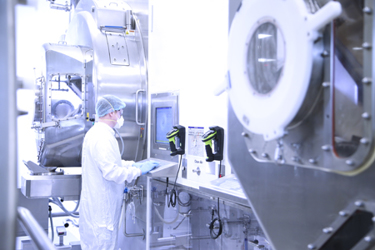
Oral solid dose (OSD) remains a dominant form in drug delivery and development and there are continual advances to improve oral solid stability, integrity and robustness through technology platforms, including coating technologies. With increasing molecule complexity posing growing challenges for formulation and manufacture, oral solids specialists require extensive expertise and cross-team collaboration to ensure project success. Technical Services Leads at Pfizer CentreOne Kieran Coffey and Sandra Conway discuss the strategies and coating technologies that can aid complex OSD formulation.
A robust grounding
A robust oral dose product starts with a strong foundation where process robustness, regulatory assessment and process optimization must be built in from the beginning of the project. Each project should be grounded in a thorough, well-planned risk assessment that factors in the potential risks and challenges relative to the program. It’s important to also think ahead to the technical considerations for scale-up, such as the interactions of the active pharmaceutical ingredients (API) and excipients and the processing or environmental conditions that may affect the API such as temperature.
Equipment design
Equipment design is also an important factor for consideration in early development. The time taken to understand the API and excipients interactions in equipment at small scale will inform the full-scale design and scale-ability, saving time and costs while providing the basis for a robust cleaning process.
Regulators now expect a thorough process and design space understanding for new or transferred processes. Small-scale manufacturing data from development work is central to satisfying this requirement.
A model for coating success
Coating unit operations exemplify how robust processes can be developed during scale-up or tech transfer. In oral solids manufacturing, coating is often seen as a simple finishing step, but this is not the case for modified release or combination products. Whatever the application, process inputs should be detailed and well-characterized.
Variation (where possible) should be removed. Where it is not possible, inputs should be controlled. If this can be successfully achieved an accurate process model can emerge to predict process behavior and monitor output.
Modelling of the process removes much of the risk associated with scale-up and tech transfer with a robust understanding of the inputs. For example, multi-particulates or cores should have a known, controlled size and weight with characterized coating material attributes in relation to particle size, density and viscosity.
Controlling the spray zone
For coating operations, the spray zone, the mixing and the thermodynamic balance of coating conditions are critical to process understanding and robustness. A coating operation is a balance of the mass and energy going into and leaving the pan. If all inputs can be measured and controlled, all activities taking place in the pan can be characterized, and outputs can be predicted.
Coating by real-time trend
Another useful technique is coating by trend. In a controlled environment there will always be some fluctuation in point data. As it is a dynamic environment, the individual parameters will move and compensate depending on the tuning of the control loops and natural fluctuation. Therefore, watching the real-time trends of the data generated for divergence or convergence, rather than monitoring data points is more useful.
Today the industry trend is toward continuous manufacturing, but most coating technologies use a plug-flow type process that also works well for modified release or combination products. Whether continuous, plug-flow or batch, the principles remain the same: understand the inputs, remove variation where possible and control the controllable.
The importance of a team
Successful coating projects call for expertise and capabilities that go beyond technology and machinery. A cross functional team should always include development scientists and engineers. However, with current expectation for process controls set so high, the group should also include a Process Analytical Technology (PAT) team. A high level of data analytics from equipment connectivity and PAT is needed to ensure real-time monitoring during manufacturing through to product testing and release.
Final thoughts
Successful OSD coating projects require good early groundwork. Understanding all the inputs from material attributes to product release, having the right equipment design, process monitoring, quality systems and working with an inter-disciplinary team are all crucial in ensuring that projects meet their goals.
 Author biography: Kieran Coffey
Kieran Coffey leads the Technology Innovation Centre at Pfizer Newbridge which is a small-scale manufacturing and development facility. Kieran has extensive experience in process scale-up, tech transfer, process development and optimization. He has led the co-development and supply of material for clinical supply and the commercialization of pipeline products.
 Author biography: Sandra Conway
Sandra Conway has 18 years of experience working on process development, technical transfers, new product introductions, process optimization, validation (process and cleaning) and troubleshooting throughout the product lifecycle for complex OSD processes. Her role at the Osmotic Centre of Excellence at Pfizer Newbridge focuses on developing optimal process for customer products from small scale capabilities to commercialization.
Need More Information? Just Ask.
Click the button below to directly contact the supplier. Use it to:
- Ask a question.
- Request more detailed information or literature.
- Discuss your current project/application.
- Request a quote.
- Locate a distributor in your area.
- Schedule a demo.