
Developability Assessment – A Key Process To Derisk The Selection Of ADC Clinical Candidates
Picking a lead ADC candidate is only half the battle. Before a molecule ever reaches CMC or manufacturing, you need to know whether it will actually survive the journey — and that's where developability assessment earns its place in the discovery process.
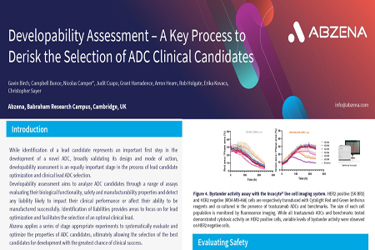
The framework presented here, developed by researchers at Abzena's Babraham Research Campus in Cambridge, covers three interconnected evaluation areas: functionality, safety, and manufacturability. Functionality is assessed through surface plasmon resonance (SPR) binding kinetics, 2D endpoint cell viability assays using CellTiter-Glo on HER2-expressing SK-BR3 cells, and live cell imaging with the Sartorius Incucyte system to characterize bystander activity. Benchmarks include Kadcyla and Enhertu, giving you meaningful reference points across a panel of trastuzumab ADCs.
On the safety side, serum stability studies track drug-antibody ratio (DAR) changes over seven days using LC-MS and HIC-UV, quantifying free payload release — a key driver of dose-limiting toxicity in the clinic. Manufacturability evaluation rounds things out with biophysical stress testing and hydrophobic interaction chromatography to flag aggregation or instability risks early.
The practical value here is cumulative: catching liabilities at this stage focuses your optimization cycles and protects your program from expensive late-stage surprises. Download the poster to review the full assay panel and comparative data across candidate molecules.
Get unlimited access to:




Enter your credentials below to log in. Not yet a member of Outsourced Pharma? Subscribe today.