
Determining Optimum Maintenance Temperature For Advanced Therapies

Understanding the proper method of safely cryopreserving your material is essential, but of equal importance is determining the optimum maintenance temperature. There are many factors that need to be considered when selecting an effective maintenance temperature. Those factors include volume, handling processes, storage, handling equipment, and the impact of multiple short duration exposures. In this article, we’ll discuss four areas that need to be understood to determine the optimum maintenance temperature for advanced therapy material.
Volume, Packaging, and Storage
Volume is perhaps the least complex but most often overlooked variable in temperature selection. At its most basic, the lower the product volume, the faster it will thaw and cross the glass transition point. Therefore, the smaller the volume, the lower the storage temperature required to ensure product integrity. There are other factors such as the type of vessel in which the product will be stored that needs to be considered in conjunction with the volume. A tear drop vial, for example, will offer more thermal protection than a standard cryovial. Additionally, if the drug is administered in multiple volumes, the actual temperature selected will need to be modified by the volume of each dose. Volume is an important factor, but only one of many.
The consideration that goes hand in hand with volume is packaging and storage configuration. The lower the volume, the greater the impact of packaging and storage decisions. It’s important to keep in mind that sound packaging and storage choices can have significant impact on the ability to maintain proper temperature of product, particularly in low volume situations.
Handling Processes and Validation
The static temperature of the material impacts the handling time. It is important to note that the impact on handling time created by lowering the static temperature is not a linear function. In this article, my colleague Alex Esmon demonstrated that as static temperature is lowered, the working time to the breach of the glass transition point increases exponentially. However, this does not mean that setting the temperature as low as possible is the best course of action because each time the temperature is lowered, the cost to store and ship increases.
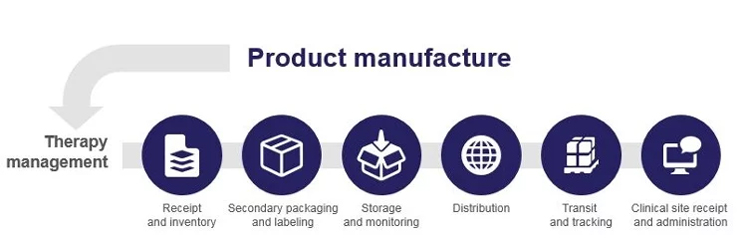
There are several points throughout the supply chain in which drug product could be exposed to non-controlled temperature conditions if diligent handling processes are not in place. Consider these potential movements:
- Control rate freezer to storage box
- Storage box to freezer rack
- Freezer rack to freezer
- Freezer to packaging and labeling processing
- Back to freezer rack
- Freezer rack to freezer
- Freezer to distribution pick/pack
- Pick/pack to distribution rack
- Distribution rack to dry shipper
- Dry shipper to thaw process
- Thaw process to bedside
How does one minimize exposure to a potential temperature excursion? The answer lies in evaluating and understanding the time each step takes and the environment in which the process takes place (ambient, -140°C CryoCart, in a -80°C freezer, etc.). Time-out-of-temperature profiles need to be established during the product development process. They must then be tested against each process step to ensure they can be performed within the time-out-of-temperature limitations. The time allowed for each step should include the time to complete the actual process plus a reasonable margin for error. Fisher BioServices has extensive experience in developing time-out-of-temperature profiles for a wide range of advanced therapy material for one simple reason. Only through understanding each process thoroughly can the optimum storage temperature be determined. The more steps you have in a given process, the greater the potential for time-out-of-temperature excursions. The time-out-of-temperature and the extremes in temperature differential will indicate the need for a lower static temperature.
The best way to ensure a product is maintained at the right temperature is to ensure that the software, equipment, and processes used are compliant with the products’ requirements throughout the chain of custody. This means that at every step of a product’s journey, all processes and equipment need to be validated.
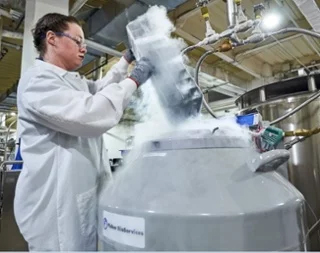 For example, we recommend completing temperature mapping studies for all movements of a drug after manufacturing is complete. This includes the hand-off and transit to short term or long-term storage, receipt and inventory, packaging and labeling, and clinical distribution. Just think about what temperatures an advanced therapy might be exposed to as it moves in and out of a storage tank. Will it make a difference if the therapy starts at -196°C or -135°C when it is exposed to ambient temperature? What about the number of exposures there are as a drug moves through its entire journey?
This is critical information for determining an optimum maintenance temperature and is important in determining whether a lower static storage temperature is necessary.
Storage Equipment
The same holds true for storage equipment. The vast majority of LN2 storage equipment has a graduated temperature profile; meaning that the product stored at the bottom of the dewar are colder than those stored at the top. The temperature differential from bottom to top varies from manufacturer to manufacturer and product to product. For example, LN2 storage units can be as cold as -196°C at the bottom of the tank and as warm as -135°C at the top.
This means that if, for example, the storage temperature is -150°C, only 65% of the storage dewar can be used. We know this because at Fisher BioServices, all of our storage tanks are thoroughly tested and validated to ensure they perform and operate within the required temperature range (-150°C to -196°C). As an example, some of the testing that is performed includes a 24-hour temperature distribution thermal mapping study, an open lid thermal mapping study, a 24-hour LN2 evaporation rate study, and a 24-hour operating temperature thermal mapping study for a loaded storage system.
The other primary consideration in selecting a maintenance temperature with regard to equipment is temperature recovery time. How often will something be added or retrieved from the storage vessel and how long will it take for the storage unit to recover (i.e., return to the optimal static storage temperature)? The more often a storage vessel is opened, the more potential there is for the product at the top of the unit to be exposed. This determination can be made by performing a series of “open door” studies. In these studies, Fisher BioServices evaluates both the impact on temperature of multiple door openings and the effect based on the length of time the door is open.
Selecting the proper temperature to maintain a viable and potent cell therapy product is a complex operation that must be approached with the same scientific vigor that went into developing the product. Validation studies at every step in the supply chain are an important tool in the development of a cell therapy. They ensure procedures are robust and will reduce variability in processes. The information above is not intended to be a definitive tool in developing a proper temperature profile, but rather a vehicle to begin the discussion.